With Euro 2024 well underway, the excitement surrounding this major sporting event has been building for several months. The anticipation of a fantastic festival of football is truly electrifying.
Our approach is multifaceted, using advanced tools to identify at-risk behaviours and deploying timely interventions. These interventions continue to improve, with our latest Journey Towards Zero release reporting an 87.4% improvement effect post-intervention, indicating a significant shift towards safer, healthier behaviour among our customers.
Major tournaments like Euro 2024 are an opportunity for us to put all that work to the test on a major scale. Players will visit our platforms in large numbers to place their bets on everything from England’s Harry Kane to score the most goals in the tournament, an ambitious Bet Builder that includes Scotland beating Germany or simply to back France to go all the way and win the tournament. And we know that from past experience of these tournaments, the overwhelming majority of players engage with our products safely.
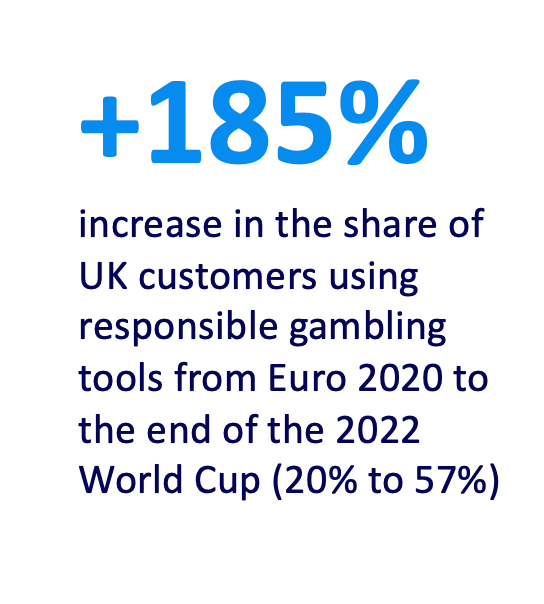
For under 25s, the results were similarly promising. Ahead of the World Cup, 40% were using at least one voluntary tool. After the World Cup, voluntary tool use was up to 58%. And compared to Euro 2020 – where around 14% of U25s were using safer gaming and betting tools during that tournament – the 58% usage represented an increase of 346% on Euro 2020.
We are proud that our focus and investment in our innovative technology is having a meaningful impact across customer behaviour. This has been made possible because of the huge advancement in technology – allowing us to develop our Player Safety Early Detection System (PS-EDS). We devote significant resources and effort towards improving our tools for identifying and helping potential problem gamers.
This sort of approach has not always been the case of course. Technology has advanced rapidly across the world in several industries. Gaming and betting is no different – with the sophisticated data held by gaming and betting companies about its customers meaning that we can forge sophisticated solutions to tackling harm. We can, for example, analyse harm in a way that many other industries – such as the alcohol sector – simply can’t. This allows us to be incredibly targeted in our interventions – ensuring that the focus always remains on those that need help while not hindering the overwhelming majority gamers safely and responsibly on our platforms.
This risk-based approach is critical in our focus to reduce gaming and betting related harm. The over-simplification of the debate at times can be challenging – this is a complicated issue and requires complex solutions. For example, the debate about spend is often littered with problems. It can of course be a part of harm in some cases, but it is usually never the only factor. Harm can occur at low levels of spend – making blanket and blunt approaches to these issues ineffective. Instead, a risk-based approach should be our collective focus. By identifying financial distress and limiting immediately, we can take decisive action where necessary. Then, everything else in a customer’s profile can be judged on merit and crucially backed by data and science.
So as Euro 2024 ignites excitement among football fans, Kindred is well placed to offer a safe and enjoyable betting experience. By deploying our technology and resources to ensure that betting remains a form of entertainment without compromising the well-being of our customers.